AI Literacy for Kids: 8 Things Every Parent Should Teach Their Child About AI
8 things parents need to teach kids about AI: from hallucinations to deepfakes to privacy. Written by a data scientist and dad.
I’ve said it before (many times) and I’m sure I’ll say it again (many times): the majority of our teenagers have used AI chatbots1 and AI companions2. Through no fault of their own, they’re using these tools, which were built for adults, not teens or kids, with no understanding of how they work or where they go wrong. Here are the 8 things you need your kid to understand deeply before they keep using AI. Read them yourself first, then teach them.
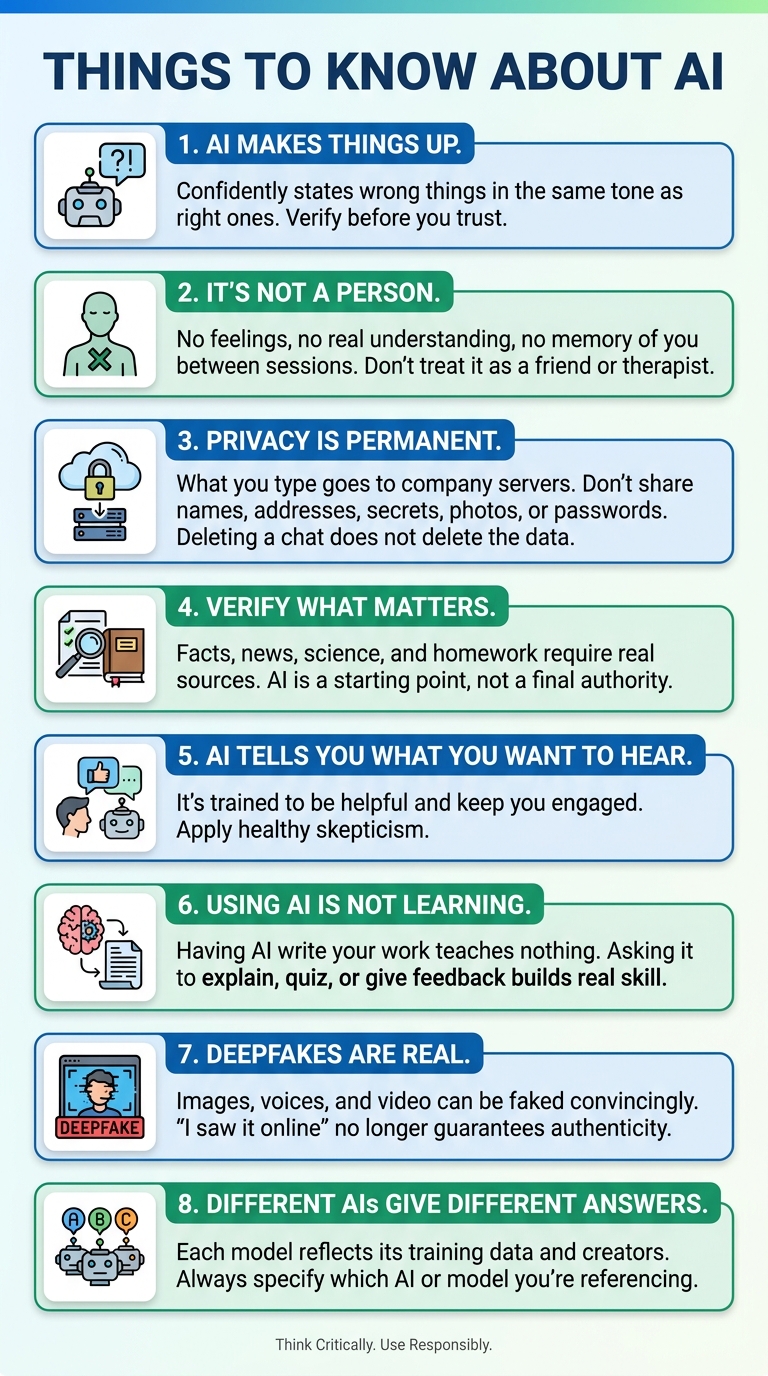
1. AI makes things up.
These are called hallucinations and they’re first on the list for a good reason. They happen often and can be really difficult to detect. The AI will say facts confidently and can even double down. Because they are literally built to find the next best word to say, it rarely, if ever, says “I don’t know.” Realizing this is the first step. Second is verifying what matters (more on that below). Third, and this comes with time and experience, is finding the common patterns of failure here.
2. AI is not a person.
AI is a master of mimicry. It has learned the patterns of human communication by reading all of the public internet (and probably more). All of that is to say that AI is really good at sounding human. It uses our pronouns, it is conversational, and it even feigns emotions. This becomes problematic when you start relying on the chatbot instead of the human alternative. Chatbots are not friends, counselors, or teachers. They can’t be these things because they are too easy, too agreeable, prone to hallucinations, and… they are not people.
3. Privacy is permanent.
Anything your child enters into a chatbot is recorded on the chatbot company’s servers… maybe forever. Also, because of the tangled web of vendor relationships, the data may live on their vendor’s servers, too. They may feel that they have nothing to hide, the problem with that is that opinions and laws change and your child may not feel this way forever. Data points can be combined to make a fuller picture, too. Oh… another thing… chatbots are not spouses, lawyers, or doctors, so none of what is told to them is protected, privileged information.
This is exactly why we built MyDD.ai. Kids get an AI chat experience that’s age-appropriate and visible to you, the parent. Free to try, then under $7/month billed annually.
4. Verify what matters.
We’ve already established that AI makes things up. Some of what it makes up is inconsequential. The things that matter, though, need verification. If it has proven something, or said something risky, or said something that changes your mind, double check it. Teach your kids to protect themselves and be reasonably skeptical of what facts a chatbot brings.
5. AI tells you what you want to hear.
It’s called sycophancy, a word which has entered the popular lexicon over the past couple of years, and it is an engagement mechanism. Chatbots are nice and agreeable on purpose, no one wants to talk to a disagreeable thing. This is why people love dogs and avoid Aunt Edna at family get-togethers. Some AI chatbots let you adjust this, which is helpful, and probably also makes the patterns more subtle. All of this is built to keep your kids using the tool longer. Be aware.
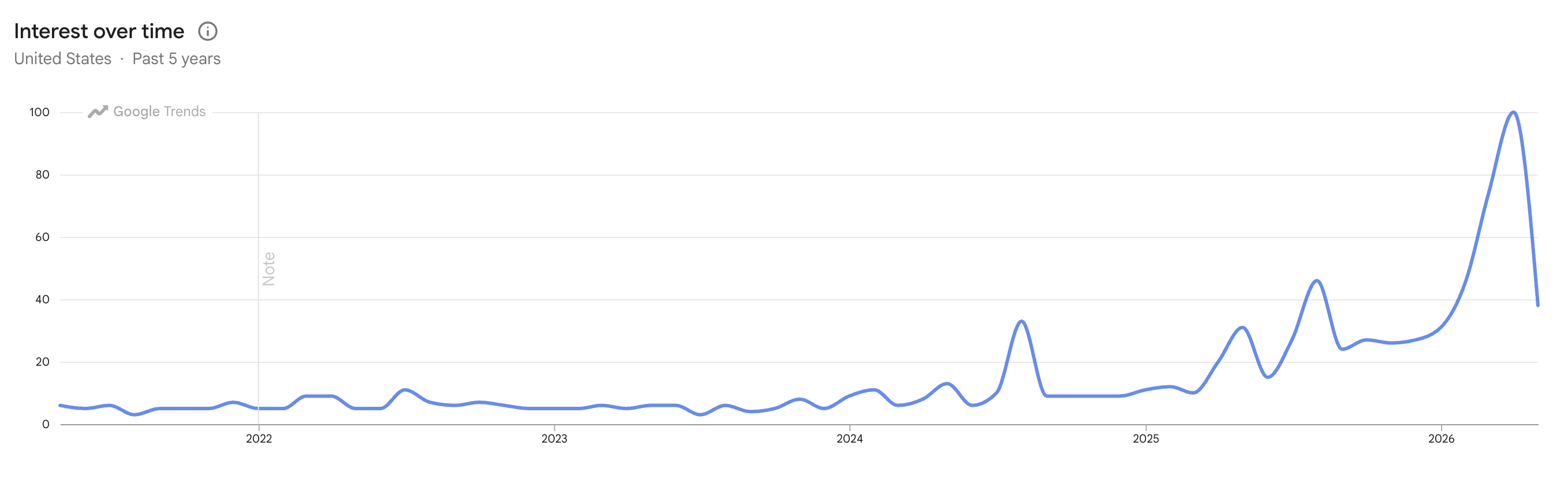 Sycophancy search interest for the last 5 years. Image credit: Google Trends.
6. Using AI Is Not the Same as Learning.
AI is really good at coding and really good at writing. Prompting for new software doesn’t make your child a software engineer. Prompting for an essay on Ender’s Game does not make your child an expert on weaponizing empathy. It can be great at explaining topics and providing additional examples in different language, which can help them learn. It is not a substitute for learning, though. To learn, they must still do the actual brain-expanding hard work. If it feels easy, your child probably hasn’t learned.
7. Deepfakes are real.
It is no longer the case that seeing is believing (if it ever was, but now especially so). Lifelike images and videos made by AI are now commonplace. Listen… I build AI for a living and even I have a hard time knowing whether these media are real or not. There is no hard-and-fast rule here. If it seems incredible, it could be, and (see above) verify what matters.
8. Different AIs give different answers.
Models reflect their training data and those who build them. Company by company, models are different. Iteration by iteration, models are different. These are amorphous things, what Ethan Mollick calls the Jagged Frontier, where capabilities improve and degrade over time. These things only predict the next best word (again, see above) and these predictions vary. It takes time and experience to get a feel for these things.
These are the 8 things kids (and parents) should understand before using AI. The “chatbots” warned about above are general-purpose tools built for adults: that’s the whole problem.
At MyDD.ai, we’re building something different: an AI chat experience designed for kids, age-gated, with parent visibility built in, and these 8 lessons baked into how it talks back. While your kid figures this out, we protect them. Free to try, then under $7/month billed annually.
Footnotes
-
64% of teens use AI chatbots. Pew Research, Dec 2025, Teens, Social Media and AI Chatbots 2025 ↩
-
72% of teens have used AI companions. Common Sense Media, Jul 2025, Talk, Trust, and Trade-Offs ↩